Types of dental prostheses
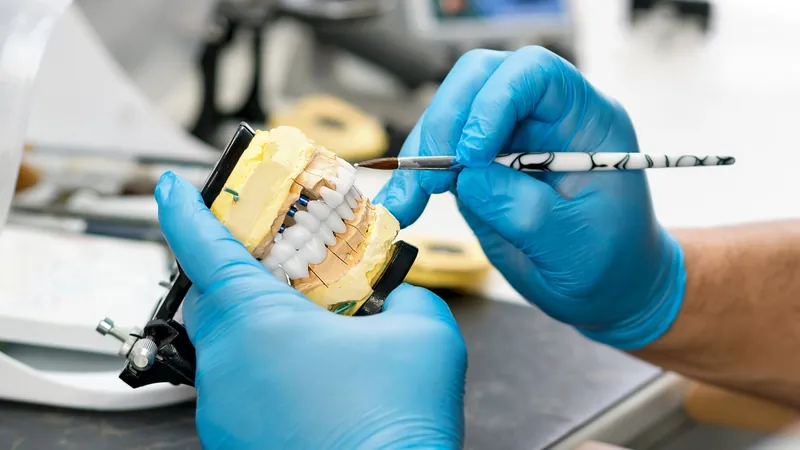
Recovering the aesthetics and functionality of the mouth is one of the most important decisions for your general health. dental prosthesis not only do they restore your ability to chew and speak correctly, but they restore confidence by smiling.
If you have doubts about what is the best option for your case, in our clinic we will be happy to make you a custom valuation to design the treatment plan that best suits you.
Looking for a trusted dentist in Bizkaia? In ODONTOFAMILY We have clinics located in Bilbao and Las Arenas (Getxo). We are specialists in integral dentistry, orthodontics, dental aesthetics and implantology. Our team offers you personalized treatments with the most advanced technology. If you live nearby and need a review, ask for your first evaluation appointment with us!
Book your visit in ODONTOFAMILY
You may also like:
Aftercare following a dental implant
Dental implants: the procedure and cost
Dental prostheses: when they are used and available options
What is a dental prosthesis?
One dental prosthesis is an artificial element designed to restore the anatomy of one or more dental pieces, allowing to recover the relationship between the maxillary ones. Its main objective is to return the chewing function, phonetics and, of course, the aesthetics lost due to the absence of natural teeth.
Provisional dental prosthesis
As its name indicates, it is used temporarily while the tissues are waiting for the scarring or the final prosthesis to be made. It is fundamental for the patient not to spend a single day without teeth, maintaining the aesthetics during the transition process towards his new smile.
Removable dental prosthesis
This is what is commonly known as “removal and ponent denture.” These prostheses are fastened to the remaining teeth by hooks or directly over the gum. They are a versatile and economical option for those looking to recover teeth quickly.
Partial dental prosthesis
The partial dental prosthesis is used when the patient still retains some of his natural teeth. These healthy teeth serve as pillars to hold the structure. It can be metal (skeleton) or resin, and its function is to prevent the rest of the teeth from moving, maintaining the correct alignment of the bite.
Fixed dental prosthesis
Unlike removable teeth, they cannot be removed by the patient. They are cemented on natural teeth previously prepared or screwed on implants. They offer superior comfort and a sensation of naturalness very similar to that of the teeth themselves.
Dental prosthesis without screws
In the field of modern implantology, there are fixed cemented prostheses or friction systems that do not require inlet holes for screws on the chewing face of the tooth. This improves the aesthetics and prevents the wear of the coating material, offering an impeccable finish.
Complete dental prosthesis
Indicated for patients who have lost all their teeth in one or both arcades. They can be mucosoportadas (they rely only on gums) or implant-supported, which offer much greater stability when anchored to implants.
What is the most recommended dental prosthesis?
There is no one-size-fits-all answer, since the most recommended dental prosthesis It depends entirely on the state of your bone, the number of teeth to replace and your budget. However, today the option that offers the highest quality of life is the prosthesis on implants, for its firmness and durability. To know what is ideal for you, we recommend you to go to our clinic for a detailed evaluation.
The latest in removable dental prosthesis
The technology has advanced enormously. Today we have materials such as thermoplastic resins and graphene, that allow to create prosthesis much lighter, flexible and without the antisthetic metal hooks of yesteryear. If you are looking for the most comfortable option within the removable, we invite you to come to see us to know these new materials.
How to clean the dental prosthesis
Maintaining rigorous hygiene is vital to prevent infections and prolong the service life of your treatment.
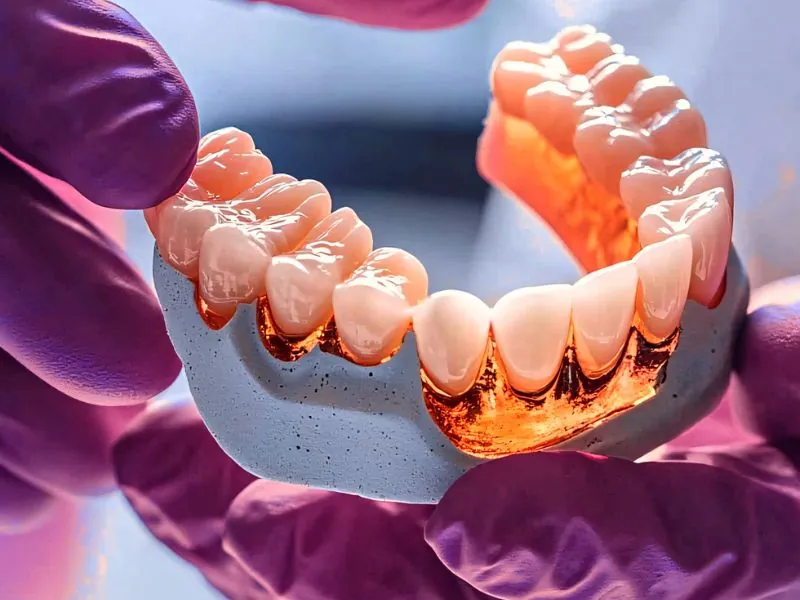
Brush for dental prosthesis
The conventional brush should not be used. There are specific prosthetic brushes with two heads: one for flat surfaces and one smaller for hard-to-reach holes.
Pills for cleaning dental prosthetics
The use of effervescent pills once a day helps to disinfect deeply and remove stains that manual brushing fails to remove, fighting bacteria that cause bad breath.
Dental implants and prosthesis
The combination of implants and prosthesis is the most advanced solution. Implants act as artificial roots, allowing the prosthesis to remain fixed, avoiding movement when eating and preventing the bone loss of the maxilla.
How much a dental prosthesis costs
The prices of dental prosthetics They vary according to material (resin, ceramics, zirconium) and complexity. A removable prosthesis is usually the most economical option initially, although it requires more adjustments over time.
How much a fixed dental prosthesis costs
The price of a fixed prosthesis is higher due to the precision of its manufacture and the high quality of the materials. However, it is a long-term investment in health. To give you an accurate budget and payment facilities, it is ideal to make a pre-treatment evaluation.
Frequently Asked Questions
I can't eat with dental prosthesis.
It is normal to go through a period of adaptation. If after a few weeks you feel pain or the prosthesis moves, you need to make a professional adjustment. Sometimes, a small clinical overlay solves the problem completely, giving you back the pleasure of eating.
How long does a dental prosthesis last?
Depending on the type. Fixed prostheses can last between 15 and 20 years with good maintenance, while removable ones usually require a renewal or adjustment at 5-8 years due to the natural change of gum and bone.
Does it hurt to put on a dental prosthesis?
The placement process is not painful. In the case of fixed implants, it is performed with local anesthesia. What does exist is a habitation process where you may feel slight discomfort or changes in pronunciation, but they disappear within a few days.
Do I have a prosthetic?
Today, aesthetics are surprisingly natural. Today’s materials mimic the translucency of enamel and the color of gum so that they are practically imperceptible to the eye.
Can I sleep with the removable prosthesis?
It is best to remove it to sleep. This allows the gum tissues to rest and remain oxygenated, preventing the proliferation of fungi or inflammations.
Ask for your evaluation appointment for your dental prosthesis
You want to get your smile back safely? At our clinic we are experts in returning functionality to your mouth. If you have doubts about which system to choose, we invite you to ask for an appointment for a treatment assessment.
Would you like us to check availability for this week and do a personalized study of your case?
General oral health information. Your dentist’s assessment is needed to tailor any recommendation to your individual circumstances.